Home inventory guide
A complete home inventory gives you proof of ownership, a faster insurance claim, cleaner estate records, and less stress when you’re moving, downsizing, or helping family manage belongings.
25-45 %
Expected Typical Estate Sale Company Commission
25-40 Hours
Manual Documentation and pricing time
6 - 10 Hours
Documentation and Pricing Time with SaveOr
Living Room Inventory
Export ready
Vintage side table • Furniture • Tagged for $400
Sailboat artwork above sofa • Art • Tagged for $175
Jewelry box • Collectibles • Referred for Professional Auction
SaveOr helps you price more accurately through research, and save all your finds in one clear place
The best time to create it is before a claim, move, estate deadline, or family handoff. SaveOr turns photos into an organized record you can review, export, and share when it counts.
Estate Sale Company? Click here

Introduction
Professional estate sale companies charge a commission of 25% to 45% of your total sale proceeds. For a sale that grosses $20,000, that's $5,000 to $9,000 paid to a company instead of kept by your family.
Professional estate sale companies typically charge 25% to 45% commission on gross sales. DIY platforms and self-managed sales can let sellers keep up to 90% of their proceeds. (DIYAuctions 2025 Estate Sale Checklist)
Here's what that commission is actually paying for: documenting what's in the home, researching prices, organizing everything for the sale, and producing a record of what sold. That's it. It's not magic, and it's not something only a professional company can do — it's organizational work, and it's exactly the work an AI-powered tool like SaveOr was built to compress from days into hours.
This guide walks through the entire DIY estate sale process with SaveOr as the engine behind it — showing specifically where it saves time, where it replaces guesswork with data, and how a family with a few open evenings can do what used to require a professional team.
Why This Is Realistic Now in a Way It Wasn't Before
The reason most families historically hired a professional company wasn't unwillingness to do the work — it was that the work itself was genuinely overwhelming without help. Cataloging hundreds or thousands of items by hand, researching a price for each one, and organizing it all into something a buyer could navigate took days of dedicated time that most families, already managing grief or a tight moving deadline, simply didn't have.
AI photo recognition has changed that calculation. The part of the process that used to take the most time — identifying items, describing them, and estimating what they're worth — now happens automatically as you photograph a room. SaveOr was built specifically around this shift: point your phone at a shelf, and the AI does in seconds what used to take minutes of typing and looking things up per item.
Without SaveOr: 3–5 days to manually catalog and price an average home.
With SaveOr: 2–4 hours using AI photo recognition for the same home.
SaveOr DIY Estate Sale Process
Whether you're creating an inventory for insurance, saving time on probate, or improving your estate plans, SaveOr has the tools to support you.
Step 1
Document the entire home
Before anything is sorted, priced, or moved, walk through the home with SaveOr and photograph each room. The AI identifies each item as you go — generating a description and an estimated current value automatically, without you typing anything.
This single step replaces what used to be the most painful part of preparing a sale: the manual inventory. Instead of a notebook, a pen, and hours of writing down item names and guessing at values, you're photographing a room the way you'd photograph it for a memory — except every photo becomes a structured, searchable, priced inventory entry in real time.
Without SaveOr: 10 Hours
With SaveOr: 2-3 Hours
Snap a photo and AI fills in the details instantly
Get an estimated value for every item you document
Edit, add notes, or assign items to rooms in one tap

Step 2
Price with AI estimates instead of guesswork
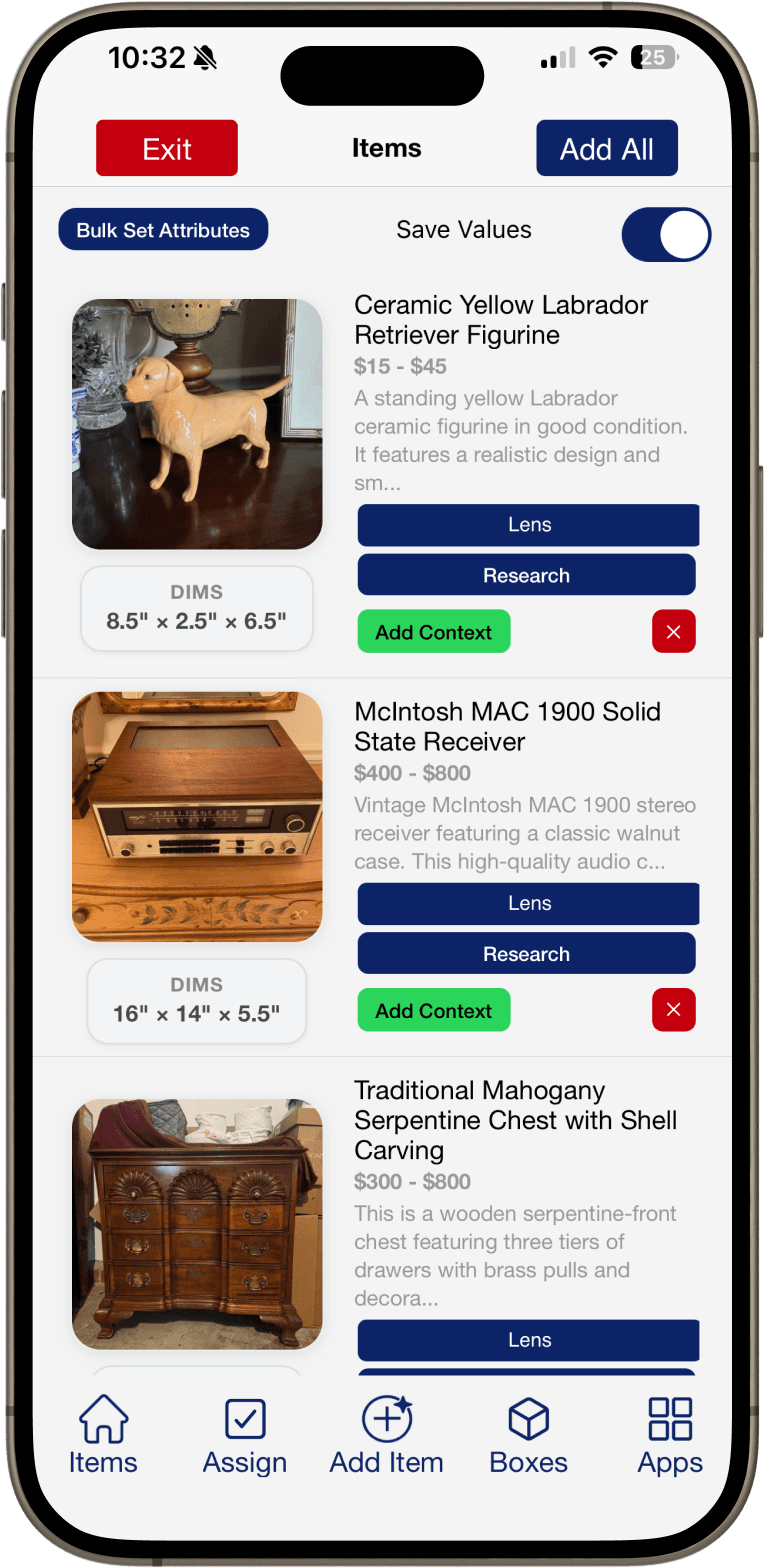
Pricing is where most DIY estate sales lose money — either by guessing too high (and watching items sit unsold) or guessing too low (and giving away value that should have gone to the family). SaveOr's AI generates a current market value estimate for each item as it's documented, giving you a defensible starting price across the bulk of ordinary household goods without any additional research.
This doesn't replace a professional appraisal for the handful of items that might be genuinely valuable — art, fine jewelry, antiques, collectibles. For those, SaveOr lets you flag the item and hold its price until an appraiser weighs in, so nothing gets sold before you know what it's actually worth. But for the hundreds of ordinary items that make up most of any estate — kitchenware, furniture, tools, books, clothing — the AI estimate means you're not spending an evening on eBay researching what a toaster is worth.
Once pricing is set, export your priced inventory directly from SaveOr. This becomes your master pricing sheet — useful for printing physical tags, and just as useful as a reference during the sale itself when a buyer asks about a specific item and you need the answer instantly, not after flipping through a notebook.
Without SaveOr: 8-15 Hours
With SaveOr: Under 2 Hours
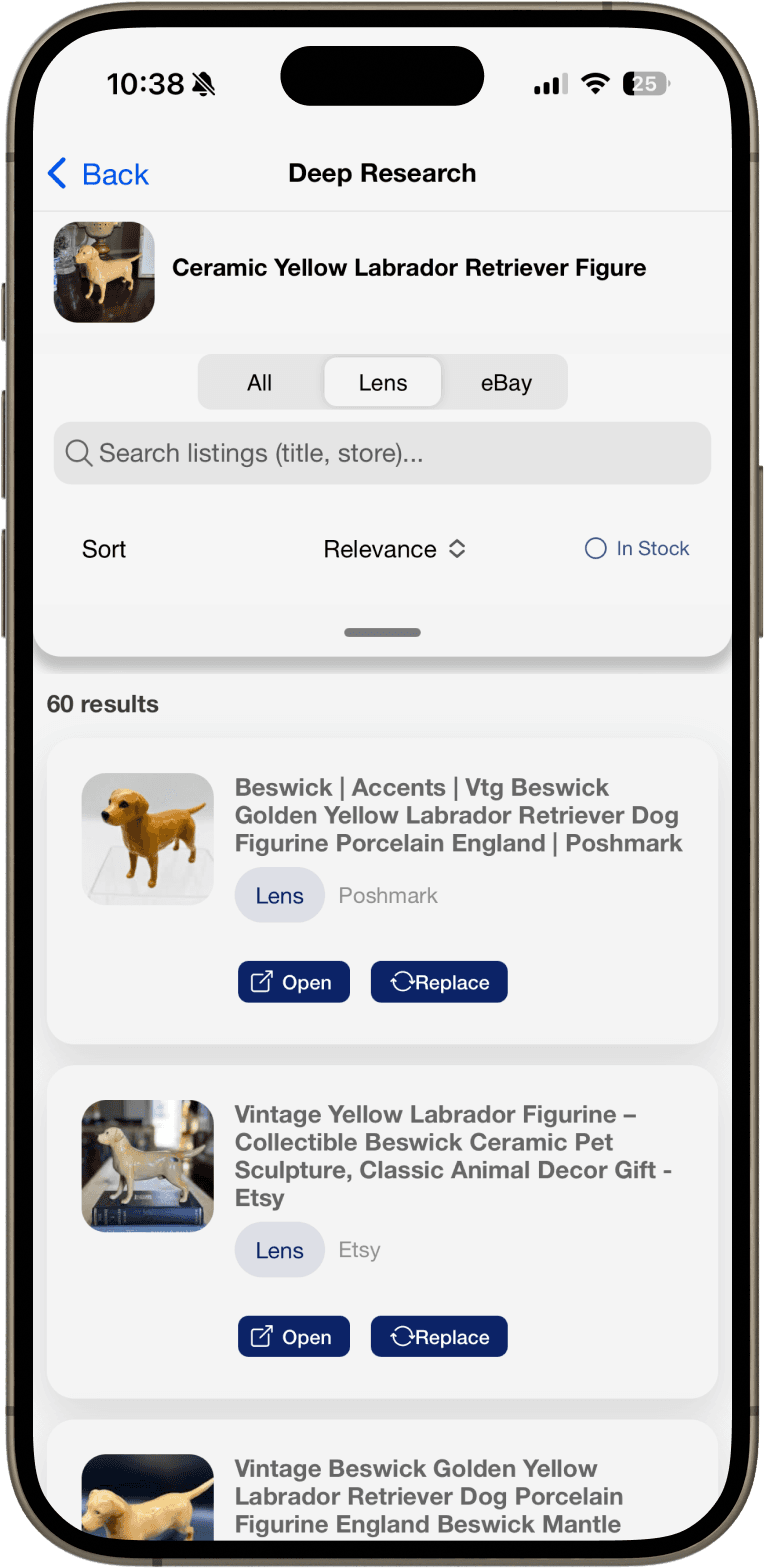
Snap a photo and AI find matches in seconds
Find the estimated value for every item you photograph
Export your list to any format
Step 3
Stage the home using your own inventory as the checklist
Staging — arranging the home so it sells like a curated shop rather than a pile of someone else's belongings — is covered in depth in the dedicated staging post in this cluster. The relevant connection to SaveOr here: because your inventory is already organized by room and category, you have a built-in checklist while staging. You're not rediscovering and resorting items as you arrange them; you're working from a list you already trust, confirming nothing was missed, and making sure higher-value items get the table space and lighting they deserve.
The photos you took during documentation also double as your staging reference — if you photographed a dining set with the table set attractively during the inventory pass, you've already done some of the staging thinking in advance.
Without SaveOr: 8-15 Hours
With SaveOr: Under 2 Hours
Step 4
Advertise using your existing photos and item list
Advertising — where to list, what to say, how to use photos — is covered in detail in the dedicated advertising post. The SaveOr connection: your documented inventory is already a photo library and an itemized list of exactly what's in the sale. Pull directly from it rather than re-photographing items specifically for your listings, and write a specific, compelling description ("mid-century modern furniture, vintage Pyrex collection, power tools") instead of a vague one, because you actually know what's in the sale down to the item level.

Step 5
Run the Sale with a Reference You Can Trust
On sale day, keep your exported SaveOr inventory on hand — on a tablet, a printed sheet, or your phone. When a buyer asks "is this firm?" or "what is this actually worth?", you have an immediate, confident answer instead of guessing on the spot or, worse, underselling something out of uncertainty.
If you're tracking sales as you go (noting what's sold against your inventory list), you'll know in real time what's moved and what hasn't — which matters directly for Stage 6.

Step 6
Handle what's left with an accurate final record
What to do with unsold items is covered in its own post in this cluster — second-day discounts, donation, buyout offers, and final disposal. The SaveOr connection: update your inventory as each item finds its final destination, so you end the process with a complete, accurate record of what sold, what was donated, and what happened to everything in the home. For an executor managing an estate, or simply a family wanting clarity, this final record — built incrementally rather than reconstructed from memory afterward — is one of the more valuable things SaveOr produces without any extra effort beyond what you've already done.

Start with SaveOr today
Start Today
Book a Call
How it Works
Book a Call
Sign up for SaveOr and feel the peace of mind that comes from getting the maximum value for your items at sale.
